

I spent most of my adult life in San Francisco.
I worked in tech, not the glamorous startup version people imagine, but the very real version. Long hours. Tight deadlines. Constant change. Meetings stacked on top of meetings. Performance reviews that shifted every six months depending on who had been promoted above you. I did well. I made good money. I worked hard. And I believed, like so many of us did, that if you stayed adaptable and kept learning, your job would be safe.
Then, three years ago, it wasn’t.
My role didn’t disappear overnight. It was “restructured.” Then “streamlined.” Then parts of it were automated. Eventually, the entire position was absorbed by software that could do the work faster and cheaper, without health insurance, without sick days, without burnout.
I remember sitting in my car in the parking garage after the final meeting, staring at the steering wheel, realizing something no one had prepared me for: I wasn’t tired of working. I was tired of working in a system that no longer valued me.
What surprised me most wasn’t the layoff. It was the grief. Not just for the job, but for the version of myself I had built around it. The commute. The badge. The lunches that were supposed to make it all feel worth it. The identity of being “successful” in a way that other people recognized.
And then, quietly, unexpectedly, I found Madison Enterprise.
I had never considered adult phone work before. Not because I was judgmental, but because I simply didn’t know it existed in the way it does. Like most people, I assumed it was something very different from what it actually is.
What I discovered instead was work that was human in the truest sense of the word.
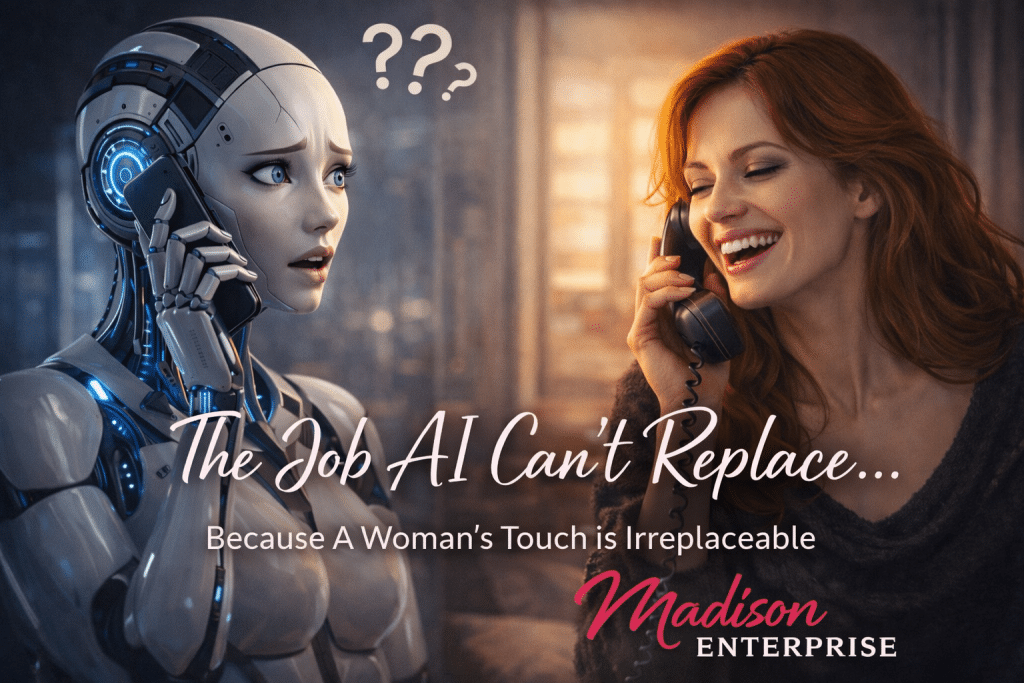
Phone work is not about scripts or automation. It’s not about speed or optimization. It’s about presence. Listening. Tone. Emotional awareness. Creativity. Intuition. You can’t outsource that. You can’t train an algorithm to replicate a woman’s warmth, curiosity, humor, or ability to read another human being in real time.
AI can generate text. It can simulate conversation. But it cannot replace connection.
That’s why this job still exists , and why it will continue to exist long after so many others disappear.
Working with Madison Enterprise didn’t feel like stepping backward. It felt like stepping out of a system that had been quietly draining me for years. I set my own schedule. I worked from home. I didn’t sit in traffic for three hours a day. I didn’t eat rushed lunches at my desk. I didn’t get talked down to by stressed managers who were just as burned out as I was.
And the biggest surprise of all? I made the same money I was making in San Francisco.
But without the stress.
Without the constant performance anxiety.
Without the feeling that I could be erased by the next software update.
Madison Enterprise is not a place for everyone. And that’s intentional. It’s a small company. Selective. Focused on long-term relationships rather than constant turnover. The women who thrive here are not chasing quick money. They’re building something steady. They show up. They learn. They grow into the role.
Many of us came from other careers. Tech. Healthcare. Education. Customer service. Jobs that promised stability and then quietly pulled the rug out from under us. What we found here wasn’t just income, it was autonomy.
There’s something deeply grounding about work that depends on who you are, not how fast you can produce or how cheaply you can be replaced. A woman’s voice. Her imagination. Her ability to hold space. These things don’t become obsolete.
They become more valuable.
As the world moves faster and more automated, people crave what feels real. They want to be heard. They want connection. They want warmth. And that’s something no machine can replicate, no matter how advanced it becomes.
For me, Madison Enterprise wasn’t a backup plan. It was a recalibration. A reminder that work doesn’t have to hurt to be meaningful. That flexibility is not laziness. That maturity is an asset, not a liability.
I don’t miss the traffic.
I don’t miss the constant pressure.
I don’t miss the feeling that my value depended on a system I couldn’t control.
What I do value now is time. Control. Privacy. And the knowledge that the work I do still requires something uniquely human.
AI will continue to change the world. That’s inevitable. But there will always be space for work that requires empathy, nuance, and real connection.
This is one of those places.
And for many of us, it’s been an unexpected blessing.
Sophie Summers
